
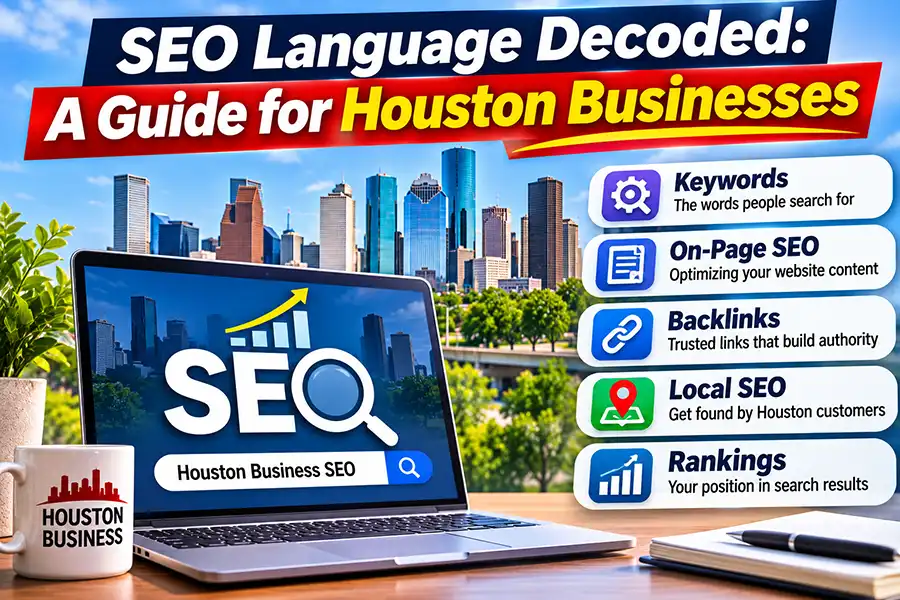
Search engine optimization is changing, and business owners are hearing terminology that may sound unfamiliar. Words like LLMO, query fan-out, AI citations, conversational search, and generative search visibility are becoming part of digital marketing discussions.
But what do these terms actually mean? Are they important for your business? And should you change your SEO strategy because of them?
At Houston Small Business Marketing, we believe understanding modern SEO terminology helps business owners make smarter marketing decisions. You do not need to become a search engine expert, but you should understand the strategies that influence how customers discover businesses online.
This guide explains several emerging SEO terms, how they relate to traditional search engine optimization, and what Houston businesses should know.
1. LLMO – Large Language Model Optimization
LLMO stands for Large Language Model Optimization.
It is an emerging industry term for strategies intended to make a business’s information easier for large language models to understand, retrieve, and potentially reference.
Large language models power tools such as ChatGPT and other AI assistants.
For example, a customer might ask:
“Which Houston company provides commercial refrigeration repair?”
An AI assistant may use information from websites and other sources to develop its response.
LLMO strategies generally focus on:
- Clearly explaining what your business does
- Publishing accurate service information
- Creating useful, well-organized content
- Establishing consistent business details
- Demonstrating relevant industry expertise
- Connecting related website pages
- Providing information that answers customer questions
LLMO is not an official Google ranking factor or a guaranteed way to appear in AI responses. It is a developing approach to improving how AI systems understand business information.
2. Query Fan-Out – How AI Search Expands a Question
Query fan-out describes how an AI-powered search system may break one broad question into multiple related searches.
For example, someone might ask:
“Who is a reliable HVAC company in Houston?”
To develop a useful response, an AI search system may explore related questions such as:
- Which Houston HVAC companies provide commercial services?
- Which companies offer emergency repairs?
- Which businesses service rooftop units?
- Which companies serve the customer’s location?
- What information is available about their experience?
- Which sources support the business information?
This is important because a business may need more than one general service page to communicate everything potential customers want to know.
A strong website should explain its services, industries served, geographic coverage, qualifications, and common customer questions.
For small businesses, this means creating useful supporting content instead of relying on one homepage to explain everything.
3. AI Citation Visibility – Being Referenced in AI Answers
AI citation visibility describes whether a business’s website or other online information is referenced as a source in AI-generated responses.
Traditional SEO often focuses on rankings, impressions, clicks, and website traffic.
AI search introduces another consideration: whether an AI-generated answer references your business or its content.
For example, a customer researching personal injury attorneys might ask an AI platform to explain how Texas accident claims work.
A law firm’s educational article could potentially be referenced if the system finds it relevant and suitable.
Businesses can work toward better information quality by:
- Publishing accurate educational resources
- Providing detailed service descriptions
- Identifying the business and its expertise clearly
- Supporting factual claims with reliable references
- Keeping important pages updated
- Organizing content around specific topics
There is no guaranteed method of earning an AI citation. Visibility can vary by platform, question, source availability, and other factors.
4. Conversational Search – Customers Ask Complete Questions
Conversational search describes searches expressed in natural language rather than short keyword phrases.
Traditional search:
“Houston plumber”
Conversational search:
“Who can repair a leaking water heater in Houston this week?”
Another example:
Traditional search:
“Auto glass Houston”
Conversational search:
“Where can I get my cracked windshield repaired near the Houston Heights?”
These longer questions often reveal more about what the customer needs.
Businesses should consider including answers to questions such as:
- What services do you provide?
- What areas do you serve?
- How much does the service typically cost?
- How long does the process take?
- When should someone contact a professional?
- What makes your company different?
This helps your website address the questions customers actually ask.
5. Entity SEO – Establishing Your Business Identity
Entity SEO focuses on helping search engines and AI systems understand a business as a distinct organization with identifiable characteristics.
For example, Houston Small Business Marketing should be clearly associated with:
- Digital marketing services
- Local SEO
- AI SEO
- Google Ads management
- Website optimization
- Content marketing
- Houston, Texas
Your business information should be accurate and consistent across your website, Google Business Profile, relevant directories, and other trusted online sources.
Important elements include:
- A complete About Us page
- Accurate business contact information
- Clearly described services
- Consistent business name and location
- Relevant organization and local business structured data
- Author and company information
- Relevant third-party business references
The objective is to make it easier for search systems and potential customers to understand who you are and what you offer.
6. Structured Data – Helping Search Engines Interpret Website Information
Structured data is a standardized way to describe information on a webpage.
It can help search engines understand specific details about your business and content.
Common structured data types include:
- LocalBusiness
- Organization
- Article
- Service
- Product
- Person
- BreadcrumbList
For example, LocalBusiness structured data can identify a business’s name, address, telephone number, website, and other applicable details.
Structured data should accurately represent information available on your website.
It does not guarantee higher rankings, AI citations, or special search appearances. Its purpose is to provide additional context in a format search engines can interpret.
7. RAG – Retrieval-Augmented Generation
RAG stands for Retrieval-Augmented Generation.
It is an AI technique in which a system retrieves relevant information from external sources and uses that information to help generate a response.
For example, an AI assistant answering a question about a company’s services may retrieve relevant information from available webpages before producing its answer.
For businesses, this highlights the importance of publishing information that is:
- Accurate
- Specific
- Clearly organized
- Easy to understand
- Relevant to the subject
- Consistent across important sources
RAG is an AI system architecture, not an SEO ranking factor. Understanding the term helps explain why the quality and clarity of your online information matter in AI-assisted experiences.
8. Topical Coverage – Building Depth Around Your Services
Topical coverage describes how thoroughly your website addresses a particular subject.
Suppose a Houston plumbing company offers water heater services.
A single page mentioning water heaters may not answer all the questions potential customers have.
Supporting content could cover:
- Water heater repair
- Tankless water heaters
- Water heater replacement
- Signs of water heater failure
- Gas versus electric water heaters
- Water heater maintenance
- Common water heater noises
Each article can link to the appropriate service page.
This creates a more complete information resource for visitors and gives search engines additional context about the subjects covered by your website.
Topical coverage should be useful and relevant rather than a reason to publish repetitive articles.
9. Brand Mentions – Your Business Name Across the Internet
A brand mention occurs when another website or online source references your business.
The mention may or may not include a clickable link.
For example, a Houston business could be mentioned in:
- Local business directories
- Industry publications
- Community websites
- News articles
- Business associations
- Relevant professional resources
- Customer reviews
Brand mentions can help people discover your company and contribute to your broader online reputation.
However, not every mention carries the same value. Relevance, accuracy, credibility, and context matter.
Businesses should focus on earning legitimate references rather than purchasing large quantities of unrelated mentions.
10. Multimodal Search – More Than Just Text
Multimodal search involves using different types of information, including text, images, audio, and sometimes video, to search for or understand content.
For example, a customer might use an image to identify a damaged auto part or use a voice assistant to ask a question about a local service.
This creates additional opportunities for businesses to organize their digital content.
Consider these practices:
- Use descriptive image filenames.
- Write meaningful image alt text.
- Publish relevant videos.
- Add useful descriptions to visual content.
- Make service information available in readable text.
- Keep important website information accessible on mobile devices.
Images and videos should support the information on your website rather than replace important written explanations.
11. Zero-Click Search – Visibility Without a Website Visit
Zero-click search occurs when someone receives an answer directly from a search results page without clicking through to a website.
This can happen through:
- Google Business Profiles
- Google Maps
- Featured snippets
- Knowledge panels
- AI Overviews
- Direct answers
For example, a customer searching for a Houston restaurant may see its phone number, address, reviews, and hours directly in Google.
The customer may call the restaurant without visiting its website.
This means website traffic is not the only way to measure marketing performance.
Businesses should also monitor:
- Phone calls
- Direction requests
- Contact form submissions
- Search impressions
- Customer inquiries
- Qualified leads
- Bookings and sales
The goal is to turn online visibility into meaningful business opportunities.
12. Search Intent – Understanding Why Someone Searches
Search intent describes what a person wants to accomplish when searching online.
A customer searching for “what is SEO” is probably looking for information.
Someone searching for “Houston SEO company” may be comparing service providers.
Someone searching for “hire local SEO company Houston” may be ready to contact an agency.
Understanding these differences helps businesses create content for different stages of the customer journey.
A complete website should include educational articles, detailed service pages, and clear calls to action.
What Do These New SEO Terms Mean for Houston Businesses?
The terminology may be changing, but the underlying objective remains the same: help potential customers find accurate information about your business when they need it.
Houston businesses should not abandon traditional SEO to chase every new marketing acronym.
Instead, focus on a balanced strategy that includes:
- Strong SEO fundamentals: Maintain a technically sound, accessible website.
- Local visibility: Keep your business information accurate and relevant to your service areas.
- Helpful content: Answer real customer questions with useful information.
- Clear business identity: Make your services, expertise, and location easy to understand.
- Relevant online reputation: Build legitimate reviews, references, and business relationships.
- Conversion optimization: Make it easy for visitors to call, request a quote, or schedule an appointment.
- Performance measurement: Track leads and business outcomes, not just rankings.
These practices create a foundation that supports traditional search and helps prepare your website for evolving AI-powered search experiences.
How Houston Small Business Marketing Helps You Adapt
At Houston Small Business Marketing, we combine established digital marketing practices with modern AI-assisted SEO strategies.
We help businesses improve their online visibility through:
- Local SEO management
- AI-powered SEO strategies
- Google Business Profile optimization
- Google Ads management
- Performance Max campaigns
- Responsive Search Ads
- Website optimization
- Technical SEO
- SEO content development
- Citation building
- Social media marketing
- Landing page development
Our approach focuses on understanding your business, your customers, your services, and the search terms that matter to your market.
We believe effective SEO should be human-led and AI-assisted. Technology can help with research and analysis, but strategy, accuracy, and business knowledge remain essential.
Learn more about our Houston Local SEO and AI SEO Services.
You can also explore our AI-Powered SEO strategies to understand how traditional optimization and AI-assisted search strategies work together.
New Terms for SEO Explained: Take the Next Step
SEO terminology will continue to evolve as search engines and AI platforms introduce new ways for customers to discover information.
You do not need to follow every industry trend. You need a marketing strategy that helps your business remain visible, communicate its value, and attract the right customers.
Understanding these new terms is a good starting point.
Need New Terms for SEO Explained?
Houston Small Business Marketing can help you understand what these changes mean for your business and identify practical opportunities to improve your online visibility.
Call 713-492-0025 to discuss your SEO strategy.
Houston Small Business Marketing
Houston, Texas
Visit our website to learn more about our digital marketing services and request a consultation.